

Amid the relentless pace, digital distraction, and inner anxiety of modern life, the ancient Christian tradition of Hesychasm (from the Greek ἡσυχία, hesychia — inner stillness and peace of heart) offers a time-tested path into the living presence of God. For more than a century and a half, two beloved classics have served as the clearest practical school for fulfilling St. Paul’s command to “pray without ceasing” (1 Thessalonians 5:17): The Way of a Pilgrim (Candid Tales of a Wanderer to His Spiritual Father) and the patristic treasury of the Philokalia (Dobrotolyubiye). In this comprehensive, step-by-step practical guide, we walk through the exact sequence of how to begin and deepen the Jesus Prayer safely, humbly, and realistically in everyday life.
Canonical Forms of the Jesus Prayer (for Daily Practice):
• Standard Full Form: “Lord Jesus Christ, Son of God, have mercy on me, a sinner.”
• Original Patristic Greek Form: “Κύριε Ἰησοῦ Χριστέ, Υἱὲ τοῦ Θεοῦ, ἐλέησόν με τὸν ἁμαρτωλόν.”
• Shorter Form (during work, fatigue, or sudden temptation): “Lord Jesus Christ, have mercy on me!” or “Jesus, Son of God, have mercy on me!”
• Intercessory Form for Others: “Lord Jesus Christ, Son of God, have mercy on Thy servant [Name]” or “have mercy on us sinners.”
At a Glance: Step-by-Step Roadmap (Steps 0 to 6)
- Step 0 — Preparing the Soil of the Heart: Forgive everyone, approach Sacrament of Confession, seek counsel from a spiritual father, choose a quiet icon corner and fixed times, stand silently for 1–2 minutes before starting, and hold a prayer rope (chotki / komboskini).
- Step 1 — Oral Prayer by Rule: Begin with 100 prayers in the morning and 100 in the evening on a prayer rope — unhurriedly, distinctly, in a soft whisper (5–7 seconds per prayer).
- Step 2 — Mental Attentiveness & Watchfulness (Nepsis): “Enclose the mind within the words of the prayer”; when thoughts wander, neither argue with them nor grow irritated with yourself — gently return attention to the Name of Jesus.
- Step 3 — Harmonizing Prayer with Natural Breathing: While inhaling calmly and naturally, mentally pray “Lord Jesus Christ, Son of God”; while exhaling gently, pray “have mercy on me, a sinner” (never forcing or holding the breath).
- Step 4 — Descent of the Mind into the Heart: Letting attention move down from anxious head-chatter to rest humbly in the spiritual center of the heart (the upper chest) in contrition, completely free of visual imagination.
- Step 5 — Unceasing Prayer Throughout the Day: Carrying short prayer ropes into commutes, walks, manual chores, 30-second pauses between tasks, and falling asleep with Christ’s Name.
- Step 6 — Living Within Scripture, the Philokalia & the Sacraments: Anchoring a 40-day habit in daily Gospel and patristic reading, repentance, Holy Communion, and active love for neighbor.
📿 Practice the Rhythm of the Jesus Prayer Right Now: Try the interactive 100-knot digital prayer rope directly in your browser at hesychasm.pray.ee/en, or download the free, 100% offline Android app on Google Play (Pray.ee — Hesychasm, Chotki & Philokalia) featuring haptic pocket prayer beads, a visual breath guide, Mount Athos soundscapes, a 40-day tracker, and all 50 chapters of the Philokalia with zero ads.
1. What Is Hesychasm? From the Desert Fathers and Mount Athos to Modern Life
The word Hesychasm comes from the Greek hesychia (ἡσυχία), meaning inner stillness, quietness of heart, freedom from turbulent passion-thoughts (logismoi), and watchful standing before the living God. The Church Fathers consistently distinguish outer silence from inner stillness: a person may say nothing aloud while inwardly boiling with resentment, vanity, or worry; conversely, a Christian working in a busy city and caring for a family can carry quiet peace with Christ deep within the heart.
Rooted in the 4th-century Desert Fathers of Egypt (St. Anthony the Great, St. Macarius, Abba Isaiah, and St. John Cassian in Scetis), refined at Mount Sinai (St. John Climacus, St. Hesychius, St. Philotheos, St. Gregory of Sinai) and Mount Athos (Nicephorus the Monk, St. Gregory Palamas, St. Nicodemus the Hagiorite), and revitalized across the Slavic lands by St. Paisius Velichkovsky and in the English-speaking world by teachers like St. Sophrony of Essex and Metropolitan Kallistos Ware, the entire patristic synthesis is preserved in the Philokalia.
2. Why The Way of a Pilgrim Is the Best Practical School of Prayer
The anonymous author of The Way of a Pilgrim was a simple, impoverished peasant with a withered arm, carrying only dried bread and a Bible in his knapsack. Hearing St. Paul’s words at the Divine Liturgy — “Pray without ceasing” (1 Thess. 5:17) — he was pierced to the heart: how can a human being pray unceasingly while working, eating, speaking, and sleeping? Sermons gave him lofty generalities about good deeds, yet his soul hungered for the exact “how-to” — what comes first, and what follows next.
God led him to an experienced monastic elder (starets), who opened the Philokalia and guided him step by step: from an unhurried oral rule on a knotted wool prayer rope, to mental attentiveness, gentle alignment with the breath, and finally the grace-filled descent of the mind into the heart. Let us examine each stage in order.
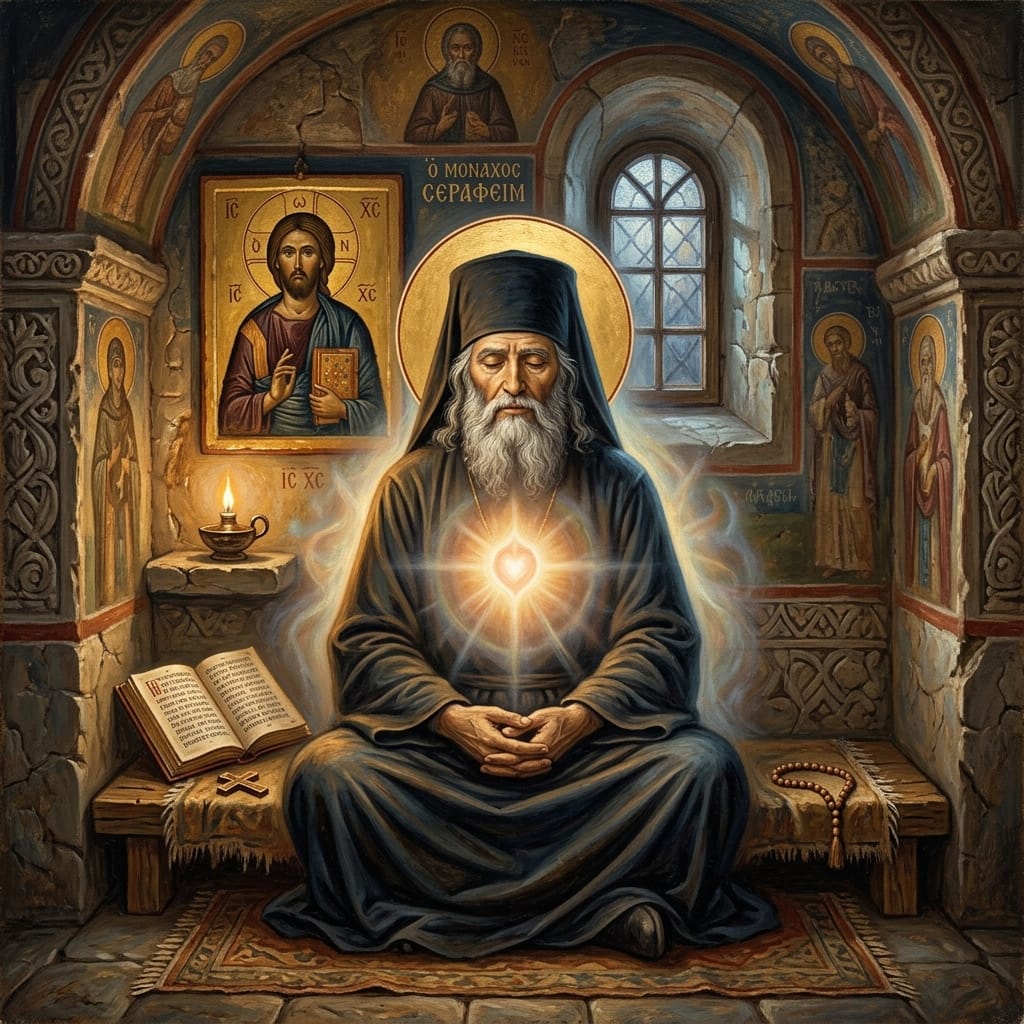
3. How to Practice the Jesus Prayer Step by Step (Steps 0 to 6)
The chief mistake of beginners is trying to leap straight to exalted contemplative states while skipping the foundation of humility and steady daily fidelity. As St. John Climacus teaches, the spiritual life is climbed rung by rung.
Step 0 (Preparation): Reconciling the Heart, Setting Time & Holding the Prayer Rope
- 1. Forgiveness and Confession: Before seeking interior stillness, forgive from the heart anyone against whom you hold resentment (Matthew 5:23–24), prepare for Sacramental Confession, and whenever possible ask the blessing and counsel of a spiritual father or parish priest.
- 2. Fixed Time and Quiet Corner: Dedicate a quiet place before an icon of Christ and the Mother of God. The two golden anchors of the day are first thing in the morning (before touching news or social media) and in the evening before sleep.
- 3. One to Two Minutes of Stillness First: Scripture counsels, “Before prayer prepare thy soul” (Sirach 18:23). Stand or sit quietly for a minute or two until your breathing settles, remembering that Christ stands invisibly before you, looking upon you with love; make the Sign of the Cross and begin.
- 4. Using a Prayer Rope (Chotki / Komboskini): Hold a 33-, 50-, or 100-knot wool prayer rope (or use the digital prayer rope at hesychasm.pray.ee/en / the Pray.ee app). Counting knots frees your mind from tracking numbers so all attention can rest on Christ.
Step 1: Oral Prayer by Rule — Quantity, Pace, and Gentle Reverence
The elder first assigned the Pilgrim 3,000 prayers a day for two weeks — forbidding him either to add or subtract on his own — then raised the rule to 6,000, and finally 12,000. Yet the Pilgrim walked alone through fields all day with no family or workplace obligations. How should a layperson in the modern world apply Step 1?
- Realistic Beginner’s Rule: As Sts. Callistus and Ignatius Xanthopoulos (Philokalia, Treatise 23) and St. Theophan the Recluse emphasize, a modest daily rule kept faithfully every day far surpasses an ambitious burst abandoned after three days. Start with 100 prayers in the morning (10–12 minutes) and 100 in the evening (10–12 minutes).
- Audible Whisper: At first, pronounce the words softly with your lips so your ears hear them. Gentle vocalization anchors a wandering mind.
- The Golden Rule of Pace: Never rush! Allow roughly 5 to 7 seconds per prayer: “Lord… Jesus Christ… Son of God… have mercy on me, a sinner.” Fifty unhurried prayers spoken from a contrite heart please God infinitely more than a thousand mechanical repetitions.
- Adding Prostrations (Metanoias): Making a bow from the waist or a full prostration every 10 knots (or 3–12 times at the close of a rope, outside Sundays and the Paschal season) unites body and soul in repentance.
Step 2: Mental Prayer & Watchfulness (Nepsis) — Dealing with Wandering Thoughts
At the second stage, apply the classic rule of St. John Climacus and St. Hesychius the Presbyter (Philokalia, Treatise 15): “Enclose your mind within the words of the prayer.” Listen inwardly to every phrase: “Lord Jesus Christ” confesses His saving Lordship; “Son of God” confesses His eternal Divinity; “have mercy on me, a sinner” places us beside the humble Publican in the Gospel (Luke 18:13).
Why do distractions multiply as soon as you pray? Beginners often panic when forgotten errands, memories, and temptations swarm their mind. The Fathers answer: when sunlight enters a dark room, floating dust motes suddenly become visible — the light did not create the dust, it revealed what was already there! Practice the three laws of Nepsis (watchfulness):
- Never converse with an intrusive thought: When a thought (prosbole) appears, do not analyze or argue with it.
- Never grow angry at yourself: Frustration over distraction is wounded pride in disguise. Acknowledge your weakness peacefully before God.
- Gently bring your mind back to the words: Even if your mind wanders 50 times in 10 minutes and you calmly return it 50 times to Jesus, each return is an act of faithful love crowned by God.
Step 3: Harmonizing the Prayer with Natural Breathing
Once oral attentiveness took root, the elder read to the Pilgrim from Nicephorus the Monk (Treatise 17), St. Symeon the New Theologian (Treatise 7), and St. Gregory of Sinai (Treatise 11) on calming the mind through the natural rhythm of breath:
- Posture: Sit quietly on a low chair (or stand reverently before the icon), relax your shoulders, and bow your head slightly toward your chest in humble contrition.
- On a calm, natural inhalation: Mentally (or in a whisper) pray: “Lord Jesus Christ, Son of God…”
- On a gentle, natural exhalation: Pray: “…have mercy on me, a sinner.”
- Essential Safeguard: Never hold your breath forcefully, strain your chest, or treat breathing as a mechanical technique that “produces” grace! Breathing is merely a peaceful physical anchor for scattered attention; grace comes solely from the Holy Spirit through faith and humility in Christ’s Name. Beginners can use the gentle visual breathing guide at hesychasm.pray.ee/en and in the Pray.ee app to maintain a calm pace.
Step 4: Descent of the Mind from the Head into the Spiritual Heart
The turning point of The Way of a Pilgrim is learning to bring attention down from the head into the spiritual heart. While prayer remains only in the intellect, thoughts stay restless and dry. St. Theophan the Recluse gives crystal-clear counsel here: never visualize the physical organ of the heart or picture lights in your imagination! Simply direct your inner awareness down from the forehead to the upper center of the chest — where conscience, sorrow for sin, gratitude, and love are naturally felt — and stand there invisibly before the Lord, crying out quietly from within: “Lord Jesus Christ, Son of God, have mercy on me, a sinner.” In God’s own time, hardness melts into compunction, deep peace, and compassionate love for all creation.
Step 5: Carrying Unceasing Prayer into Work, Commutes, and Daily Duties
The Pilgrim prayed while walking through forests and villages, conversing with companions, and even when robbers stole his Bible and Philokalia — responding with such peaceful forgiveness that the thieves repented and returned his books! In modern life, Step 5 unfolds naturally:
- Commutes & Walking: While walking, driving, riding transit, or waiting in lines, replace idle scrolling with quiet prayer ropes using a pocket chotki or the silent Haptic Chotki mode in the Pray.ee app.
- 30-Second Micro-Prayers Between Tasks: Before answering a difficult email, entering a meeting, or switching tasks, pause for three slow breaths with the Jesus Prayer.
- Manual & Household Tasks: While cooking, cleaning, or exercising, let the Name of Jesus flow quietly in the background of your heart.
- Falling Asleep in Prayer: As St. Anthony the Great teaches in Chapter 170 (Philokalia, Treatise 1), falling asleep in thanksgiving and prayer turns bodily rest into spiritual watchfulness.
Step 6: Uniting Prayer with Scripture, the Philokalia, Confession & the Eucharist
The Pilgrim never isolated the Jesus Prayer from the fullness of Church life: he read the Gospels and the Philokalia daily, made a thorough life confession in his Fourth Tale, received the Holy Mysteries of Christ’s Body and Blood with burning love, and served the blind and the poor. True spiritual fruit is measured never by visions or spiritual pride, but by the fruits of the Holy Spirit (Galatians 5:22–23): deeper humility, slower anger, quicker forgiveness, patience in trials, and genuine love for neighbor.
4. Sample Daily Schedule for a Lay Christian (Morning to Night)
- Upon Waking (1 minute): Before touching your phone, make the Sign of the Cross and pray the Jesus Prayer slowly three times, offering your first thought to Christ.
- Morning Rule (15–20 minutes): Morning prayers + 100 unhurried Jesus Prayers on the prayer rope + one short passage from the Gospel or Philokalia.
- Morning Commute / Walk (10–15 minutes): 50–100 quiet prayers using pocket beads or Pray.ee haptic vibrations.
- During Work & Difficult Encounters: Whenever stress or irritation arises, pause inwardly before speaking and pray: “Lord Jesus Christ, have mercy on me and on Thy servant!”
- Midday Reset (5 minutes): 33 slow prayers aligned with calm breathing to restore inward peace.
- Evening Rule & Examination of Conscience (15–20 minutes): Thank God for the day, repent of failings, pray 100 attentive Jesus Prayers, and drift to sleep calling gently upon Jesus.
5. Five Common Obstacles in Practice — and Patristic Solutions
- Spiritual Dryness (Feeling Nothing): Days will come when your heart feels like stone. The Fathers teach that God withdraws sensible consolation so we learn to love Him for Himself rather than for pleasant feelings. One prayer rope offered faithfully in dryness outweighs ten in effortless consolation!
- Listlessness, Drowsiness & Acedia: When sleepiness or procrastination strikes specifically at prayer time, St. John Cassian (Philokalia, Treatise 46) counsels washing your face with cool water, making a few prostrations, praying softly aloud, and never abandoning your small set rule.
- Irritation & Provocations from People: Often right after prayer someone speaks sharply to us. View this as the testing ground of authentic Hesychasm — swallow anger and pray silently for that person.
- “I Have No Time”: Checking our daily phone screen-time quickly reveals that waking 10 minutes earlier gives ample space for 100 peaceful prayers.
- Discouragement After Falling: After a missed rule or a fall into sin, the enemy whispers, “Give up.” The Desert Fathers answer: “Did you fall? Rise up immediately and call upon Jesus again!”
6. A Practical 40-Day Plan to Build a Steadfast Habit
Across Scripture and Orthodox tradition, 40 days is the sacred measure for spiritual renewal and establishing deep inner transformation. Follow this gentle four-stage progression:
- Days 1–10 (Foundation): 100 slow Jesus Prayers every morning + 100 every evening without rushing and without missing a single day.
- Days 11–20 (Watchfulness): 150 morning + 150 evening prayers, adding 10 minutes of daily reading from The Way of a Pilgrim or the Philokalia.
- Days 21–30 (Breath & Daily Walk): 200 morning + 200 evening prayers harmonized with calm breathing, plus 100 prayers during daily walks or commutes (500/day).
- Days 31–40 (Depth & Sacramental Union): 500–1,000 unhurried prayers across the day according to your schedule, culminating in Sacramental Confession and Holy Communion.
7. Your Digital Companion: hesychasm.pray.ee & the Pray.ee Offline App
Our phones often fragment our attention, yet we can reclaim them as quiet instruments of watchfulness and patristic reading:
- 🌐 Interactive Web Digital Chotki — hesychasm.pray.ee/en: Practice a 100-knot prayer rope directly in your browser with optional gentle bell cues to learn an unhurried rhythm.
- 📱 100% Offline Android App on Google Play — Pray.ee (Free Download): Built specifically for Hesychast prayer with zero ads and complete offline privacy:
- 📿 Haptic Digital Chotki: Subtle vibration on every knot and a longer pulse every 10 prayers let you pray with eyes closed in the dark or with your phone tucked discreetly in your pocket while walking.
- 🫁 Breath Synchronization Guide: Gentle visual pacing grounded in St. Gregory Palamas and the Fathers of the Philokalia.
- 🌧️ Monastic Soundscapes: Peaceful Mount Athos rain, forest wind, or monastery bells to quiet urban noise.
- 📅 40-Day Rule Tracker & Private Spiritual Journal: Track daily consistency (streaks) without vainglory and record notes from your spiritual father locally on your device.
- 📚 Complete Offline Library in OLED Dark Mode: Read all 50 treatises of the Philokalia, The Way of a Pilgrim, and canonical Akathists anywhere offline.
8. Seven Patristic Safeguards Against Spiritual Delusion (Prelest)
St. Gregory of Sinai (Philokalia, Treatise 10) stresses that true prayer walks the royal path of humility:
- Never treat the prayer as an occult mantra: Grace is never produced automatically by vocal or breathing mechanics; it is the free gift of the living Lord Jesus Christ.
- Reject all visual imagination during prayer: Never picture lights, angels, or faces in your mind’s eye; keep the intellect completely formless and attentive to the words alone.
- Never boast in numbers: Counting knots is for steady discipline, never for feeling superior to others (Luke 18:11).
- Never strain breathing or chest muscles: Everything in genuine Hesychasm is gentle, peaceful, and unforced.
- Never despise liturgical worship: The Jesus Prayer deepens our participation in the Divine Liturgy, Morning/Evening Prayers, and the Psalter — it never replaces the Church.
- Never neglect family or work duties: Serving your spouse, children, or neighbor in love is inseparable from loving Christ.
- Walk with counsel and patristic guidance: Humility, obedience to spiritual counsel, and regular reading of the Fathers guard the soul from every deception.
9. Join the Conversation Below! Would You Like a Telegram Community?
Dear brothers and sisters in Christ! Throughout The Way of a Pilgrim, whenever the wanderer met fellow seekers and shared spiritual conversation, both hearts were kindled with fresh courage. As Scripture says, “Iron sharpeneth iron; so a man sharpeneth the countenance of his friend” (Proverbs 27:17).
We warmly invite you to share your thoughts in the comments section below:
- 💬 1. Your Practice & Questions: Have you begun practicing the Jesus Prayer or reading The Way of a Pilgrim and the Philokalia? Which step helps you most, and what challenges (such as wandering thoughts or busyness) do you encounter?
- 📲 2. Creating a Spiritual Community on Telegram: Please let us know in the comments — would you be interested if we created a dedicated Telegram community / channel where we can read through the 50 treatises of the Philokalia and The Way of a Pilgrim together day by day, encourage one another in the 40-day prayer rule, and share patristic reflections?
We read every single comment carefully — if enough readers would love such a fellowship, we will gladly launch it and post the invitation right here!
10. Frequently Asked Questions (FAQ)
How many Jesus Prayers a day should a beginner start with?
For laypeople living in the world, starting with 100 unhurried prayers in the morning (about 10–12 minutes) and 100 in the evening on a prayer rope is ideal. Consistency, humility, and calm attention matter far more than high numbers.
Can married Christians with demanding jobs practice Hesychasm?
Yes, wholeheartedly. Both St. Symeon the New Theologian (Philokalia, Discourse on Faith) and St. Gregory Palamas affirm that St. Paul’s command to pray without ceasing (1 Thess. 5:17) belongs to every baptized Christian in the world as well as to monastics.
What should I do when my mind constantly wanders during the Jesus Prayer?
Do not argue with the intruding thoughts and do not get frustrated with yourself. Simply and gently bring your attention back to the words of the prayer each time you notice distraction. That patient returning is the very heart of watchfulness (Nepsis).
Does the Jesus Prayer replace Morning and Evening Prayers?
For beginners, the Jesus Prayer complements and deepens standard Morning and Evening Prayers rather than replacing them. With a spiritual father’s blessing, prayer ropes may occasionally substitute when traveling or ill.
Where can I find a digital prayer rope and offline Philokalia app?
You can use the interactive 100-knot prayer rope directly in your browser at https://hesychasm.pray.ee/en/ or install the free, ad-free Pray.ee Android app on Google Play featuring haptic chotki beads, a 40-day tracker, and all 50 chapters of the Philokalia offline.
How can I tell if my practice of the Jesus Prayer is bearing true spiritual fruit?
Authentic fruit is shown not in visions or spiritual pride, but in growing humility, contrition, patience when wronged, quicker forgiveness, inward peace, and deeper love for God and neighbor.
11. Canonical & Patristic Sources
- The Way of a Pilgrim (Candid Tales of a Wanderer to His Spiritual Father) — Full Text Online (Pray.ee)
- The Philokalia (Dobrotolyubiye) — Complete 50 Patristic Treatises Online (Pray.ee)
- Pray.ee Hesychasm Portal — Digital Chotki, Breath Guide & 40-Day Rule (hesychasm.pray.ee/en)
- Holy Scripture: 1 Thessalonians 5:16–18; Luke 18:9–14; Matthew 5:8, 6:6; Psalm 51 (50 LXX).
- St. Paisius Velichkovsky, Little Russian Philokalia / On Mental or Interior Prayer.
- Metropolitan Kallistos Ware, The Power of the Name: The Jesus Prayer in Orthodox Spirituality.